
Stargazer’s Guide: Top Celestial Events to Watch in October 2026
- Posted by ocadsite
- On October 1, 2026
- 0 Comments
- 3200 Phaethon, Aldebaran, Antares, Aquarid meteor shower, Beehive cluster, Beehive cluster M44, Cool Astronomy Videos, Jupiter, Mercury, meteor shower, Orange County, Orionid meteor shower
October is turning out to be an absolute paradise for stargazers, night-owl photographers, and casual skywatchers alike. Whether you're tracking bright planetary alignments, hunting for distant asteroids, or wishing upon shooting stars, the October 2026 night sky is serving up a front-row seat to cosmic magic.
Grab a cozy blanket, a hot beverage, and your favorite pair of binoculars—here is your complete day-by-day guide to the best night sky events this month.
📅 October 2026 Night Sky Highlights
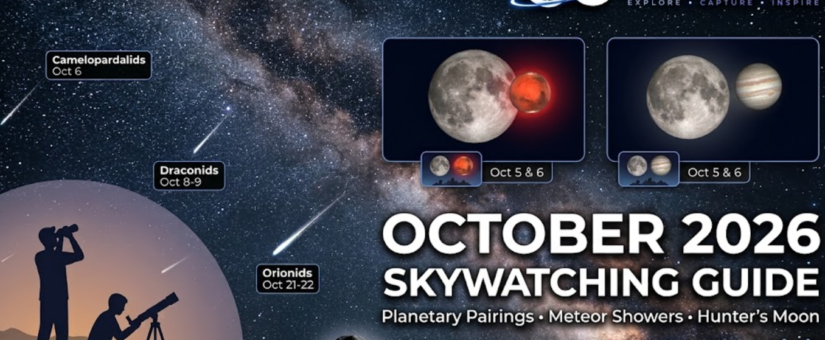
🌙🔴 October 5–6: A Planetary Double Header
Kick off the month with back-to-back close celestial encounters in the evening sky:
- October 5: The Moon makes a close approach to Mars, making the Red Planet easy to identify right alongside the lunar crescent.
- October 6: The Moon glides past Jupiter. This extremely tight pairing between the Moon and the solar system's largest planet will be one of the brightest photogenic alignments of the season.
☄️ October 6 & 8–9: Early-Month Meteor Showers
- October 6: The minor Camelopardalid meteor shower reaches its peak near the northern sky. While low in activity, it offers a nice viewing bonus alongside Jupiter and Mars.
- October 8–9: The Draconids reach their peak. Unlike most meteor showers that favor the pre-dawn hours, the Draconids are best viewed in the early evening. Under favorable dark skies, keep your eyes focused toward the northern constellation Draco.
☿ & 🪨 October 12–13: Inner Planets & Asteroids
- October 12 – Mercury at Greatest Eastern Elongation: Mercury reaches its highest point above the horizon in the evening sky, giving you the best opportunity of the month to spot the innermost planet low in the west just after sunset.
- October 13 – Asteroid Vesta at Opposition: Asteroid 4 Vesta—the second-most massive body in the main asteroid belt—reaches opposition. Positioned directly opposite the Sun from Earth, it will reach peak brightness and be visible through binoculars or a small telescope.
☄️ October 21–22: The Peak of the Orionid Meteor Shower
The main spectacle for meteor hunters arrives mid-month. Known for producing fast, bright meteors with persistent glowing trails, the Orionids are formed from dust and debris left behind by Halley’s Comet. For the best experience, head outside during the late night hours of October 21 into the pre-dawn sky of October 22.
🌕 ✨ October 26 & 28: The Full Hunter’s Moon & The Pleiades
- October 26 – Full Hunter’s Moon: October’s full moon lights up the autumn sky. Rising shortly after sunset, the Hunter's Moon casts a distinct golden hue over the evening landscape.
- October 28: Just two days after reaching peak illumination, the Moon drifts right past the famous Pleiades star cluster (the "Seven Sisters"), creating a striking naked-eye pairing in the eastern sky.
🔭 Tips for Skywatching Success
- Escape Light Pollution: Travel away from bright city lights, particularly when viewing meteor showers like the Draconids and Orionids.
- Allow Dark Adaptation: Give your eyes 20 to 30 minutes to adjust fully to the dark without looking at phone screens.
- Use Stargazing Apps: Utilize free sky-mapping software such as Stellarium or SkyView to quickly pinpoint planets and constellations from your exact location.
Clear skies, and happy stargazing!