August 2026 Sky
- Posted by ocadsite
- On August 3, 2026
- 0 Comments
- Antares, Castor, Mars, Mercury, Moon, Perseids, Pleiades, Pollux, Saturn, Venus
August 2026 Sky
| 2 | Mercury at westernmost elongation at 8h UT (19.5° from Sun, morning sky). Mag. 0.3. |
| 3 | Moon near Saturn at 23h UT (morning sky). Mag. 0.6. |
| 6 | Last Quarter Moon at 2:22 UT. |
| 6 | Mercury 7.6° South of Pollux at 6h UT (20° from Sun, morning sky).Mags. −0.4. |
| 7 | Moon near the Pleiades at 8h UT (morning sky). |
| 9 | Moon near Mars at 7h UT (morning sky). Mag. 1.3. |
| 9 | Moon, Mars and M35 within 4.9° circle at 9h UT (48° from Sun, morning sky). |
| 9 | Moon near M35 Cluster at 13h UT (morning sky). |
| 10 | Moon at perigee (closest to Earth) at 11:18 UT (distance 363,284km; angular size 32.9′). |
| 10 | Moon near Castor at 17h UT (morning sky). |
| 10 | Moon near Pollux at 23h UT (morning sky). |
| 11 | Moon near Mercury at 15h UT (16° from Sun, morning sky). Mag. −0.9. |
| 12 | Perseid meteor shower peaks night of Aug 12-13. Peak lasts about 12 hours. Active from July 17 to August 24. Produces swift, bright meteors (30-50 per hour) with persistent trains. Best viewed from a dark rural location in the Northern Hemisphere. • Perseids (AMS) |
| 12 | Total Solar Eclipse from 16:58 to 18:34 UT, greatest eclipse at 17:46 UT (duration 2m 18s). Totality visible along narrow path crossing Arctic, Greenland, Iceland and Spain. Partial eclipse visible across northern North America, UK, Europe and western parts of Africa. • Total Solar Eclipse of 2026 August 12 (GIF) (NASA) • 10 Things to Know About the August 2026 Total Solar Eclipse (Time & Date) • Solar Eclipses: 2021 – 2040 (Mr Eclipse) • NASA Solar Eclipse Page (NASA) |
| 12 | New Moon at 17:36 UT. Start of lunation 1282. |
| 12 | Venus at dichotomy (D-shape crescent) at 20h UT. |
| 14 | Mars 0.6° South of M35 Cluster at 23h UT (50° from Sun, morning sky). Mag. 1.3. |
| 15 | Venus at easternmost elongation at 6h UT (45.9° from Sun, evening sky). Mag. −4.3. |
| 15 | Mars at northernmost declination (23.7°) at 16h UT (morning sky). Mag. 1.3. |
| 16 | Moon near Venus at 8h UT (evening sky). Mag. −4.3. |
| 17 | Moon near Spica at 11h UT (evening sky). |
| 20 | First Quarter Moon at 2:45 UT. |
| 21 | Moon near Antares at 3h UT (evening sky). Occultation visible from Antarctica, Argentina, Chile and Falkland Islands. • Lunar occultation of Antares (In-the-Sky) |
| 22 | Moon at apogee (farthest from Earth) at 9h UT (distance 404,642km; angular size 29.5′). |
| 27 | Mercury at superior conjunction with the Sun at 17h UT (not visible). The innermost planet passes into the evening sky. |
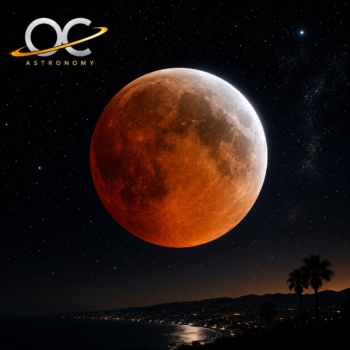
| 28 | Partial Eclipse of the Moon from 2:34 to 5:52 UT, mid-eclipse at 4:13 UT. Visible from the Americas, Europe and Africa. • NASA Lunar Eclipses: 2021-2030 (NASA) • Partial Lunar Eclipse of 2026 August 28 (PDF) (NASA) |
| 28 | Full Moon at 4:19 UT. |
| 31 | Moon near Saturn at 3h UT (morning sky). Mag. 0.5. |
All times Universal Time (UT).
|
|