July 2018 Sky
- Posted by OCastronomy
- On July 1, 2018
- 0 Comments
- Aldebaran, Antares, Beehive cluster M44, Jupiter, Lunar Eclipse, Mars, Mercury, Partial Eclipse of the Sun, Regulus, Saturn, Solar Eclipse, Spica, Total Eclipse of the Moon, Venus
July 2018 Sky

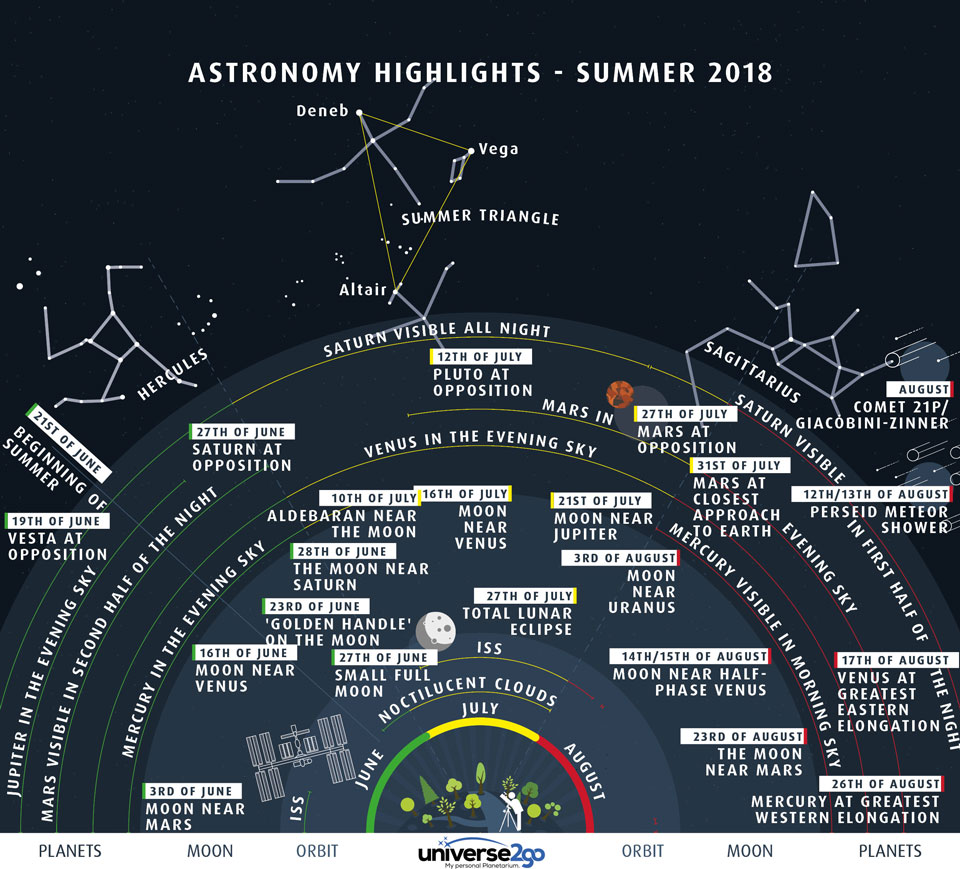
| 4 | Mercury 0.4° SSW of Beehive cluster M44 (25° from Sun, evening sky) at 13h UT. Mag. 0.1. • Beehive Cluster (Wikipedia) • M44: The Beehive Cluster (APOD) |
| 6 | Last Quarter Moon at 7:52 UT. |
| 6 | Earth at Aphelion (farthest from Sun) at 17h UT. The Sun-Earth distance is 1.016696 a.u. or about 152.1 million km. • Earth at Aphelion (SpaceWeather.com) • Photographic Size Comparison (Anthony Ayiomamitis) |
| 10 | Venus 1.0° NNE of Regulus (42° from Sun, evening sky) at 5h UT. Mags. −4.1 and 1.4. |
| 10 | Moon near Aldebaran (morning sky) at 9h UT. • Aldebaran (Wikipedia) |
| 12 | Mercury at greatest elongation east (26° from Sun, evening sky) at 5h UT. Mag. 0.5. |
| 13 | New Moon at 2:48 UT. Start of lunation 1182. |
| 13 | Partial Eclipse of the Sun at 3:01 UT (greatest). Minor event. Visible from southern Australia and Tasmania. Begins at 1:48, ends at 4:14 UT. • Solar Eclipses: 2011 – 2030 (Mr Eclipse) • Partial Solar Eclipse of 2018 July 13 (GIF) |
| 13 | Moon at perigee (closest to Earth) at 8:27 UT (357,341 km; angular size 33.4′). |
| 14 | Moon near Mercury (26° from Sun, evening sky) at 23h UT. Mag. 0.6. |
| 15 | Moon near Regulus (evening sky) at 17h UT. • Regulus (Wikipedia) |
| 16 | Moon near Venus (43° from Sun, evening sky) at 4h UT. Mag. −4.1. |
| 19 | Moon near Spica (evening sky) at 14h UT. • Spica (Wikipedia) |
| 19 | First Quarter Moon at 19:53 UT. |
| 21 | Moon near Jupiter (evening sky) at 3h UT. Mag. −2.2. |
| 23 | Moon near Antares (evening sky) at 7h UT. • Antares (Wikipedia) |
| 25 | Moon near Saturn (evening sky) at 6h UT. Mag. 0.2. |
| 27 | Moon at apogee (farthest from Earth) at 6h UT (distance 406,223 km; angular size 29.4′). |
| 27 | Mars at opposition at 5h UT. Mag. −2.8. At its brightest. • The 2018 Perihelic Appartition of Mars (ALPO) |
| 27 | Moon near Mars (evening sky) at 20h UT. Mag. −2.8. |
| 27 | Total Eclipse of the Moon begins at 18:24 UT and ends at 22:19 UT. Mid-eclipse at 20:23 UT. Partial phases begin at 17:15 UT and end at 23:29 UT. Moon appears red-orange in color during totality (the color of Earth’s sunsets). Visible from South America, Europe, Africa, India, Asia, and Australia. Mars nearby. • Lunar Eclipses: 2011 – 2030 (NASA) • Total Lunar Eclipse of 2018 July 27 (PDF) (NASA) |
| 27 | Full Moon at 20:21 UT. • Full Moon Names (Wikipedia) |
| 31 | Mars nearest to Earth at 8h UT. Mag. −2.8. |
| July 2018 Sky All times Universal Time (UT). | |